

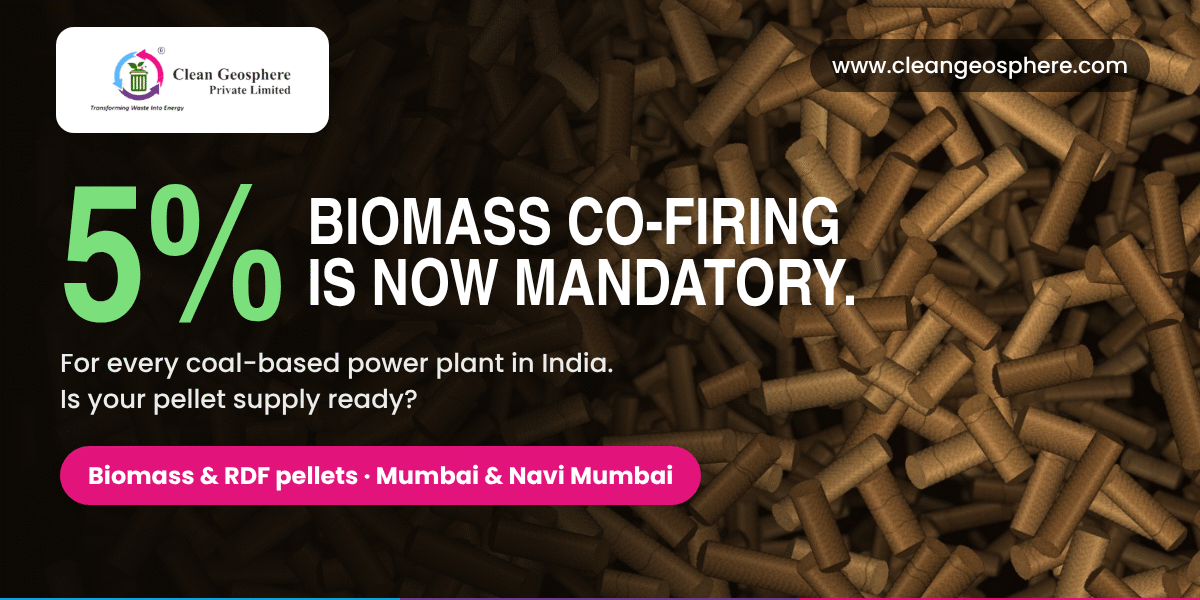
Biomass Pellets: India’s 5% Co-Firing Mandate and Why Your Fuel Supply Matters
Every coal-based thermal power plant in India must now burn at least 5% biomass pellets alongside its coal. What used to be a pilot project is now a compliance requirement, and it is changing how industries think about fuel.
For plant heads, procurement teams and sustainability leads, the question is no longer whether to use biomass pellets. It is where to get a steady, quality-assured supply. This guide explains what the rule says, what pellets are, who should switch, and what to look for in a supplier.
What the new policy says
On 7 November 2025, the Ministry of Power issued a consolidated policy on co-firing in coal-based thermal power plants. It applies from FY 2025-26 and brings together the earlier 2021 and 2023 biomass rules (Down To Earth).
| Plant location | Minimum co-firing (by weight) |
|---|---|
| Outside Delhi-NCR | 5% biomass pellets or torrefied MSW charcoal |
| Delhi-NCR and adjoining areas | 5% biomass pellets + 2% more biomass or torrefied MSW charcoal (7% total) |
The policy also lets plants recover co-firing costs through their energy charge, which removes a major cost barrier. In short, demand for pellets is now built into the power sector, and it will only grow.
What are biomass pellets?
Biomass pellets are small, dense cylinders of compressed organic material such as crop residue, sawdust and husk. Loose biomass is bulky, wet and uneven. Pelletising turns it into a uniform, easy-to-handle fuel that behaves predictably in a boiler or furnace.
Why industries are switching from coal:
- Lower emissions. Pellets come from renewable plant material and cut the carbon footprint of every tonne of coal they replace.
- Consistent calorific value. Uniform size and density give steady combustion and predictable heat output.
- Low ash. Agro and wood pellets leave less residue, which means less ash handling and cleaner boilers.
- Works with existing systems. Pellets can be co-fired with coal in existing boilers and furnaces, often with minimal changes.
- Fixes another problem. Every tonne of pellets uses crop residue that might otherwise be burnt in fields or dumped.
Biomass pellets vs RDF pellets
There are two main kinds of waste-derived pellets, and each suits a different use.
| Biomass pellets | RDF pellets | |
|---|---|---|
| Made from | Rice husk, bagasse, sawdust, wheat straw, cotton stalk, other agro and wood residue | Segregated dry municipal waste: paper, packaging, textile, non-recyclable plastic |
| Key strength | Low ash, consistent burn | High calorific value |
| Best for | Power plant co-firing, industrial boilers | Cement kilns, high-temperature furnaces |
RDF stands for Refuse-Derived Fuel. It gives a second life to dry waste that cannot be recycled and keeps it out of landfills.
Who should be using pellets
Power plants have a legal requirement, but they are not the only ones. Any business that burns fuel for heat can cut costs and emissions with pellets:
- Thermal power plants, to meet the 5% (or 7% in NCR) co-firing requirement
- Cement plants, using RDF as an alternative fuel in kilns
- Textile mills, for boilers that run steam and dyeing processes
- Food processing units, for boilers, dryers and process heat
- Chemical and pharmaceutical plants, for steam generation
- Any industry with boilers or furnaces that wants to report lower emissions in its ESG and BRSR disclosures
How good pellets are made
Pellet quality is decided at every step of production. Here is how it works at our plant:
- Collect and segregate. Biomass and dry waste are collected and sorted, and anything that would contaminate the fuel is removed.
- Dry. Moisture is brought down to 10–15%, which is key for clean burning and durable pellets.
- Grind. A hammer mill breaks the material into uniform particles.
- Pelletise and cool. High pressure compresses the material into dense pellets, which are then cooled to harden.
- Screen and pack. Fines are screened out and the pellets are packed in bags or supplied in bulk.
Before you sign with a supplier, ask for test results on these five parameters: moisture, bulk density, calorific value, ash content and durability. Consistent numbers batch after batch matter more than one good lab report.
The real challenge: a steady supply
Most plants that struggle with co-firing don’t have a boiler problem. They have a supply problem. Crop residue is seasonal, small suppliers are inconsistent, and quality varies from truck to truck.
That is where Clean Geosphere comes in. Since 2019 we have built one of Mumbai’s most dependable waste collection and processing networks. Today we turn that network into fuel:
- 2 TPH pellet plant at TTC-MIDC, Turbhe, Navi Mumbai
- Biomass and RDF pellets from one supplier
- Year-round raw material from our own collection and logistics network
- Quality-checked batches for moisture, density, calorific value, ash and durability
- Bagged or bulk supply across Mumbai and Navi Mumbai
The shift away from coal is already here. Make sure your fuel supply is ready for it.
Talk to us about your pellet requirement:
- Call or WhatsApp: +91 80972 45784
- Toll-free: 1800 4199793
- Email: contact@cleangeosphere.com
- Web: www.cleangeosphere.com